Updated on by Rita Moreira
If you have ever timed yourself and wondered whether you are painfully slow, take a breath: a realistic pencil drawing is meant to take hours, not minutes. The time you spend is not wasted effort, it is the work itself.
Below I have set out honest time ranges by complexity, from a two-minute sketch to a hyperrealistic portrait, plus what actually makes a drawing take longer and why patience, not speed, is the skill worth building.
How long does a drawing take?
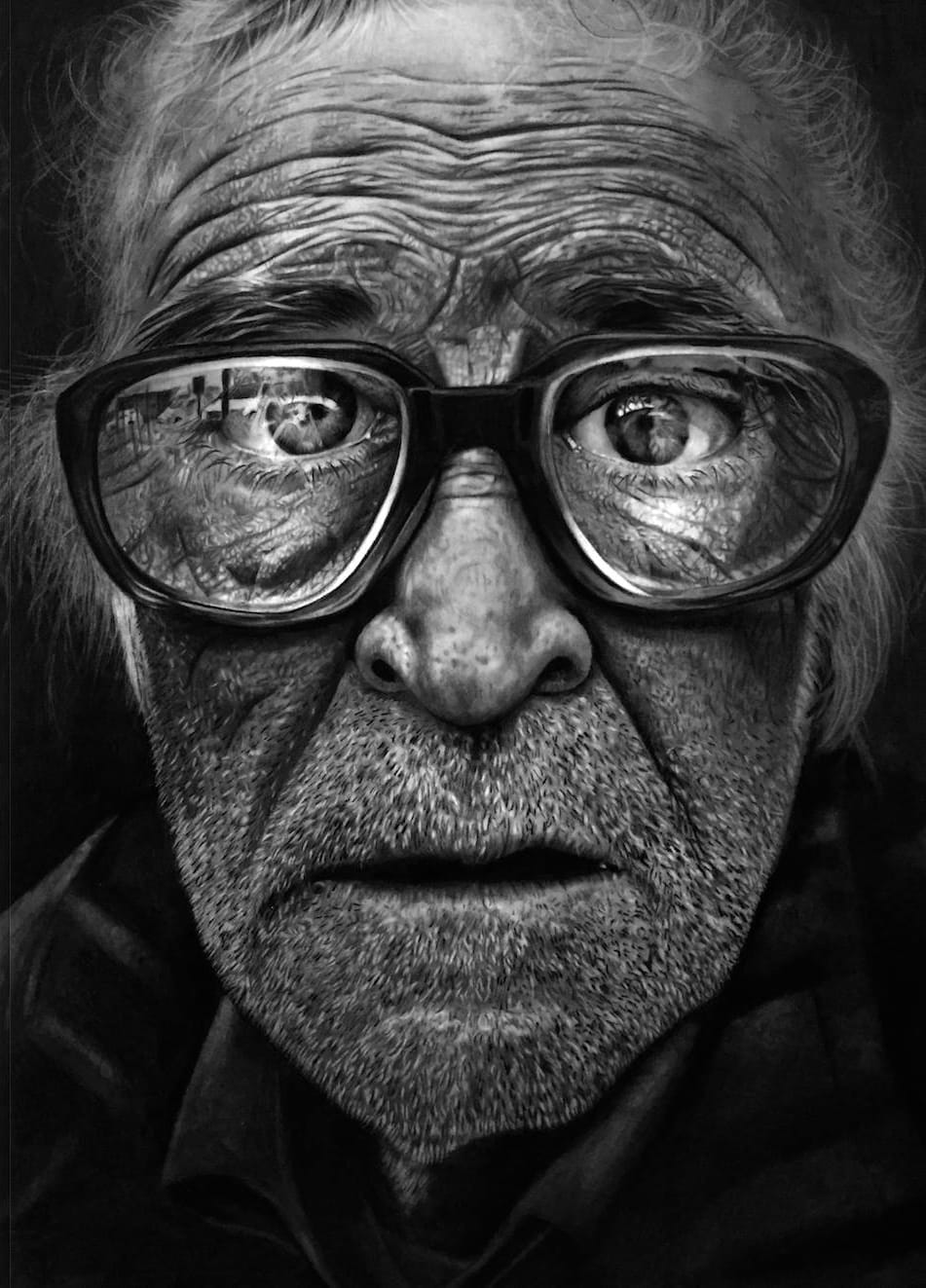
A realistic pencil drawing usually takes anywhere from a few hours to well over a hundred, depending on complexity. A loose sketch is done in minutes. A careful A4 portrait with full shading and skin texture sits around 20 to 30 hours of focused work, while ambitious hyperrealistic pieces can demand 100, 200 or even 300 hours. There is no single “correct” figure.
The honest answer is that time scales with realism. The more faithfully you want to reproduce every tonal shift, every pore and every stray hair, the more hours the drawing quietly asks of you. That is not a flaw in your speed; it is the nature of the medium.
Realistic pencil drawing times by complexity
| Type of drawing | Typical time | What drives the hours |
|---|---|---|
| Quick sketch | 5 to 20 minutes | Loose shapes, no shading, capturing a gesture |
| Detailed study | 3 to 8 hours | One feature or object, careful values |
| Realistic portrait | 20 to 30 hours | Whole face, skin texture, hair, proportions |
| Hyperrealistic piece | 100 to 300 hours | Pore-level detail, flawless gradients |
Treat these as ballpark figures, not targets. A beginner will sit at the upper end of each band while the eye and hand are still learning; with a bit of practice the same drawing comes together faster, though a serious artist rarely rushes. If you want to close that gap, it is worth reading how to get better at drawing through steady practice rather than speed.
How long should a drawing take?
A drawing should take as long as the result you are aiming for demands, and no less. If you want a quick, expressive study, ten minutes is perfectly right. If you want a convincing realistic portrait, giving it only an hour will show, because the tones stay flat and the details never resolve. Match the time to the ambition.
The mistake I see most often in my students is deciding in advance that a piece “should” be finished by lunchtime, then racing the clock instead of watching the drawing. When you rush a realistic drawing, the fine transitions between light and shadow are the first thing to suffer, and those transitions are exactly what sells the illusion. Slow, deliberate practice sessions teach the hand far more than frantic ones.
How long does a sketch take?
A sketch is the fast end of the scale: most take between 5 and 20 minutes, and a rough gesture drawing can be over in under a minute. A sketch is meant to catch shapes, proportion and movement quickly, so speed is a feature here rather than a compromise. It is the block-in stage, not the finished piece.
It helps to keep the two ideas separate in your head. A sketch is where you make your decisions cheaply; the finished realistic drawing is where you spend the hours making those decisions look effortless. Many of my best portraits started life as a five-minute scribble that fixed the pose before I committed a single hour to shading.
Why do realistic drawings take so long?
Realistic drawing takes so long because it is relentless, close observation made visible. Every proportion has to be measured, every subtle shift of tone laid down, every texture of skin, hair or fabric built up in patient layers. One weak passage anywhere can break the illusion, so nothing can be skipped. The realism you admire is simply the sum of hundreds of tiny, correct decisions.
This is why the whole tradition of Photorealism, as defined by the Tate, prizes painstaking accuracy over speed, and why Realism as a movement, in the National Gallery’s words, set out to depict subjects truthfully rather than idealise them. Truthful depiction is slow work by definition. If your realistic pieces still feel off despite the hours, it is often a values problem, and it is worth studying light and shadow before you blame your speed.
What the masters spend: 100 to 300 hours
If you think you are slow, look at the artists working at the very top. Dirk Dzimirsky, the German hyperrealist known for intense human expressions, builds his drawings over more than 100 hours each, sometimes reaching several hundred. His piece “Insomnia” (2015), in charcoal and acrylic, shows what that kind of patience buys you.
The Italian artist Emanuele Dascanio works the same way, combining charcoal and graphite over more than 100 hours per piece. His drawing “This is my Father” (2013) reportedly took around 300 hours. These figures are not a warning; they are permission. If the artists you admire take that long, you are allowed to as well. You can see how this level of finish is built up in a hyperrealistic pencil drawing.
How I learned that patience is the skill
We live in a culture of the immediate. We are anxious to reach the next stage, then the one after that, always rushing towards a finish line that keeps moving. That restlessness follows us to the drawing board, where it does real harm, because a calm, quiet mind is exactly what lets your perception settle on the subject and read its detail honestly.
I can prove the point with two of my own graphite portraits. The first, drawn on Canson paper when I was starting out in realistic work, took me roughly 10 hours. The second, a more recent piece on Bristol paper, took closer to 40. The difference in quality is obvious, and almost all of it came from being willing to slow down and keep going. Learning to draw a little every day did more for my patience than any single technique.
You do not need much to start putting in those hours. A single HB and a 4B graphite pencil are genuinely enough at first; you will find Derwent Graphic pencils and good cartridge paper at Cass Art, Hobbycraft or Jackson’s Art, with Amazon.co.uk an easy option too. The materials matter far less than the willingness to sit with the drawing.
Frequently Asked Questions
How long should a drawing take?
A drawing should take as long as your intended result needs. A quick sketch is right at 5 to 20 minutes, while a finished realistic portrait fairly asks for 20 to 30 hours or more.
There is no universal number to hit, and comparing your pace to someone else’s is rarely useful. Rather than racing a clock, match your time to your ambition for the piece, and let the level of realism you want decide the hours. Rushing simply shows up as flat, unconvincing tone that no amount of tidying will rescue afterwards.
How long does a sketch take?
A sketch usually takes 5 to 20 minutes, and a loose gesture drawing can be finished in under a minute. Its job is to capture proportion and movement quickly, so working fast is the whole point.
Keep the sketch separate from the finished drawing in your mind. The sketch is where you make cheap, fast decisions about pose and layout; the realistic drawing is where you invest the hours turning those decisions into believable detail. Getting the sketch right first actually saves time later, because you never have to unpick a badly placed feature halfway through the shading.
How long does a realistic pencil drawing take?
A realistic pencil drawing typically takes 20 to 30 hours for an A4 portrait, and 100 hours or more for hyperrealistic work. Beginners sit at the upper end while their observation is still developing.
Time scales directly with the realism you want. Every extra layer of tone, texture and fine detail adds hours, which is exactly why professional hyperrealists such as Dirk Dzimirsky and Emanuele Dascanio routinely spend well over 100 hours on a single piece. If you are a beginner, expect the first few portraits to take longer, and treat that as normal rather than a sign of slowness.
Did this article help you? You can buy me a coffee so I can keep creating free guides like this one.