Updated on by Rita Moreira
Realist paintings can stop you in a gallery in a way few pictures do: a field of stubble, a tired face, a wet cobbled street, all painted as if you could walk straight into them. This was a deliberate choice by 19th and 20th century artists who turned away from myth and drama to look hard at ordinary life.
Below I have gathered the most famous realist paintings you can trace to real collections, many of them a short walk apart in London, plus what each one can teach you when you sit down with a pencil.
What counts as a famous realist painting?
A famous realist painting is a 19th or 20th century work that shows everyday life and the visible world without idealising it. The movement began in France around 1848 with Gustave Courbet, who rejected grand historical subjects in favour of labourers, farmers and plain scenes. Both the Tate and the National Gallery hold key examples.
Realism was partly a reaction against Romanticism, and it borrowed courage from the new medium of photography. The National Gallery in London defines it as the honest depiction of contemporary life, and that honesty, painting people and work as they really looked, is what still makes these pictures feel so alive.
Famous realism paintings of the 19th century
The 19th century is the heart of realist painting, and most of the household names sit here. Gustave Courbet led the way: his huge A Burial at Ornans (1849 to 1850) put ordinary villagers on a canvas the size usually reserved for kings, and the National Gallery holds his quieter Still Life with Apples and a Pomegranate.
Jean-Francois Millet gave us The Gleaners (1857), three peasant women stooping to pick leftover grain, now in the Musee d’Orsay in Paris. Rosa Bonheur, one of the most celebrated women painters of the century and a name worth knowing among famous female artists, painted the thundering The Horse Fair (1852 to 1855), today in the Metropolitan Museum of Art, New York.
Two more belong on any serious list. Ilya Repin’s Barge Haulers on the Volga (1870 to 1873), in the State Russian Museum, shows eleven exhausted men dragging a boat upriver. Edouard Manet’s The Execution of Maximilian survives as fragments in the National Gallery, painted with a cool, reportorial eye.
| Artist | Painting | Year | Where it hangs |
|---|---|---|---|
| Gustave Courbet | A Burial at Ornans | 1849 to 1850 | Musee d’Orsay, Paris |
| Jean-Francois Millet | The Gleaners | 1857 | Musee d’Orsay, Paris |
| Rosa Bonheur | The Horse Fair | 1852 to 1855 | Met Museum, New York |
| Ilya Repin | Barge Haulers on the Volga | 1870 to 1873 | State Russian Museum |
| Thomas Eakins | The Gross Clinic | 1875 | Philadelphia |
Famous realism paintings of the 20th century
Realism did not stop in 1900. In the United States it grew quieter and lonelier. Edward Hopper’s Nighthawks (1942), in the Art Institute of Chicago, shows four figures in a late-night diner, and it has become one of the most recognisable images of the whole century.
Andrew Wyeth’s Christina’s World (1948), in the Museum of Modern Art in New York, sets a woman in a vast pale field, painted blade by blade in egg tempera. In Britain, L.S. Lowry filled his canvases with the mills and crowds of industrial Lancashire, and the Tate holds a large group of his work.
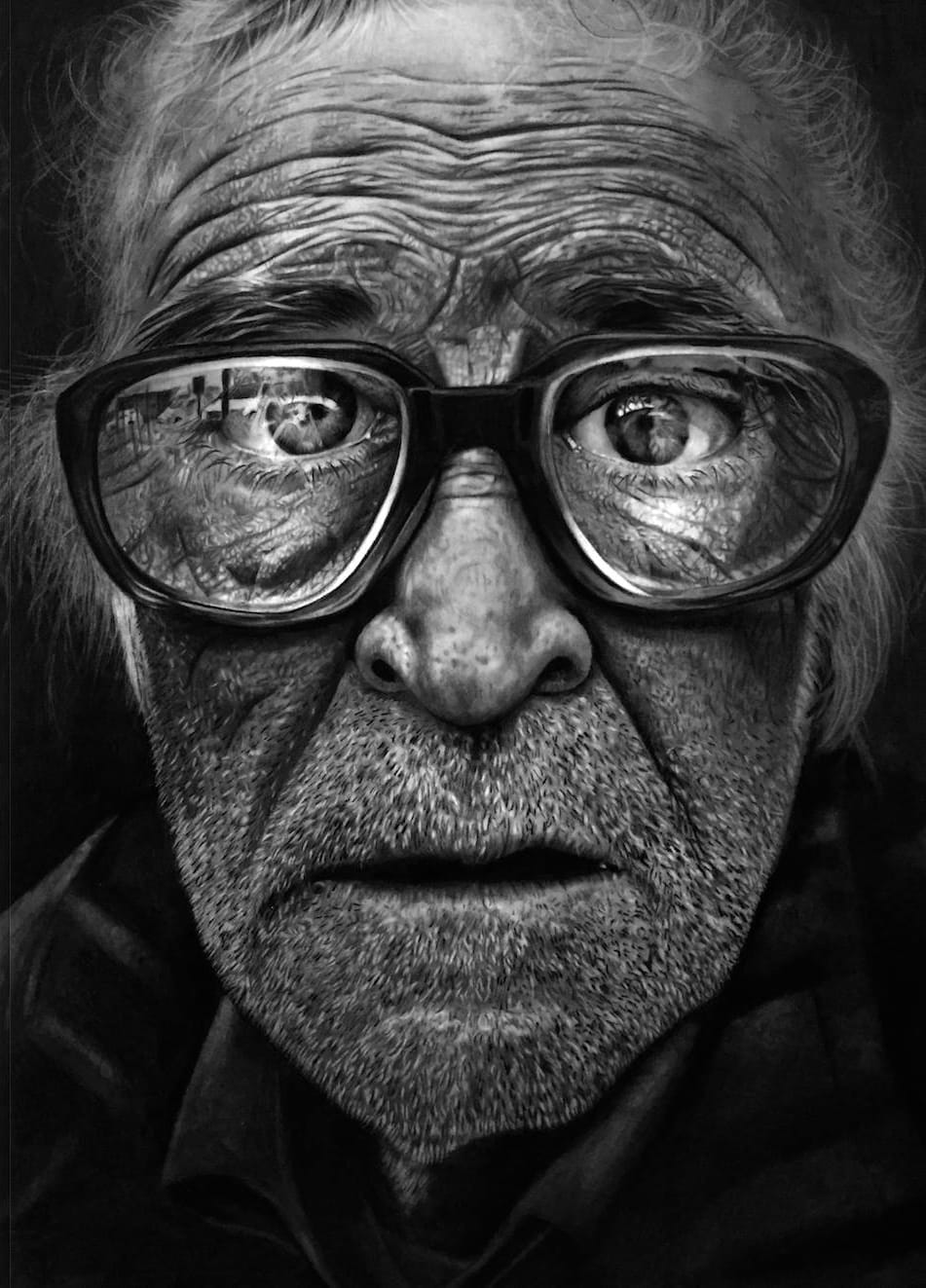
Later in the century realism pushed even further towards the photograph. Photorealism and hyperrealism, associated with painters such as Chuck Close, aimed to match a camera detail for detail. If you enjoy that precision, our guides to realistic pencil drawing chase the same goal in graphite.
Famous realistic paintings of nature
Realistic paintings of nature ask a different sort of patience: no story to lean on, just light, weather and texture observed closely. Courbet returned again and again to the sea, and his rolling wave studies show water as a solid, heaving mass rather than a pretty backdrop.
Rosa Bonheur built her whole career on animals, sketching from life in slaughterhouses and stables so that every muscle read true. In America, Winslow Homer painted the Atlantic with the same unsentimental honesty, salt spray and grey swell and all. Studying these works is quietly the best training there is for light and shadow drawing, because nature never poses.
What unites these nature paintings with the portraits above is refusal to tidy the subject up. A field is left muddy, a sky left heavy. That commitment to drawing what you actually see, rather than what you assume is there, is the single habit that separates realist work from everything else.
Who are the famous realist painters, then and today?
The famous realist painters of the 19th century are Courbet, Millet, Honore Daumier, Rosa Bonheur, Ilya Repin and the American Thomas Eakins, whose The Gross Clinic (1875) shows surgery with almost clinical nerve. Walter Sickert carried a grittier realism into early 20th century London, and the Tate holds his music-hall and interior scenes.
Today the tradition lives on in hyperrealism, and increasingly in pencil rather than paint. Contemporary graphite and coloured-pencil artists produce portraits so fine they are mistaken for photographs. It is honest, patient work, and it is exactly the kind of drawing our community shares, one careful pencil at a time.
What these paintings can teach your own realistic drawing
You do not need oil paints to learn from the realists. When I copy a Courbet still life in graphite, the first thing I notice is how much of the effect comes from a few very dark accents against soft mid-greys: get those darkest darks in early and the whole drawing snaps into place. That is a lesson you can practise tonight with an HB and a 4B pencil.
The second lesson is patience with edges. Millet and Wyeth let some edges melt and keep others crisp, and that control of hard and soft edges is what makes a face or a field read as real. It is the same principle I lean on when teaching how to draw a realistic face: sharp where the light strikes, softer in shadow.
I always tell my students that copying a master is not cheating but studying, and there is good reason to believe copying helps you improve. Pick one painting from this list, work small, and use decent graphite pencils: in the UK, Derwent (made in the Lake District since 1832) are a proud local choice, easy to find at Cass Art, Jackson’s Art or Hobbycraft, with Amazon.co.uk as an obvious fallback.
Frequently Asked Questions
What are famous realism paintings of the 19th century?
The most famous 19th century realist paintings include Gustave Courbet’s A Burial at Ornans and Jean-Francois Millet’s The Gleaners, both in the Musee d’Orsay, along with Rosa Bonheur’s The Horse Fair in New York.
Ilya Repin’s Barge Haulers on the Volga and Thomas Eakins’s The Gross Clinic (1875) belong on the list too, along with Edouard Manet’s cool, reportorial scenes. In London you can see both Courbet and Manet at the National Gallery, which makes it a fine place to start looking at 19th century realism in person.
What are famous realistic paintings of nature?
Famous realistic paintings of nature include Gustave Courbet’s crashing wave studies of the Normandy coast and Winslow Homer’s grey Atlantic seascapes, both painted with no attempt to prettify the water.
Rosa Bonheur’s animal pictures, drawn from close study of live horses and cattle, are the other great strand of realist nature painting. What these works share is patient observation of light, weather and texture, with nothing tidied up or invented, which is exactly why they reward anyone learning to draw from life rather than from imagination.
Who are famous realist painters today?
There is no single household name today the way Courbet dominated his century, but the realist tradition thrives in the hyperrealism movement. Painters such as the late Chuck Close pushed photographic detail to its limit.
Much of the most exciting realist work now happens in pencil rather than paint, not oil on canvas. Contemporary graphite and coloured-pencil artists produce portraits so fine they are mistaken for photographs, and communities of self-taught realists, ours included, keep that patient skill growing and sharing it one careful drawing at a time.
Did this article help you? You can buy me a coffee so I can keep creating free guides like this one.