Updated on by Rita Moreira
Cartoon vs realistic drawing is not a contest between serious art and playful art. It is a choice of language: one simplifies and exaggerates to communicate quickly, while the other observes and builds resemblance patiently.
I am Rita Moreira, and when I teach this comparison I start with purpose before technique. The same photograph can lead to a faithful portrait, a caricature or a satirical cartoon, but the artist’s intention changes every decision on the paper.
What is the difference between cartoon and realistic drawing?
Cartoon vs realistic drawing differs mainly in purpose: realistic drawing seeks faithful resemblance through observation, proportion, light and shadow, while cartoon drawing simplifies or exaggerates forms to communicate character, humour, criticism or story. Both can use strong drawing skills, but they use those skills in opposite ways.
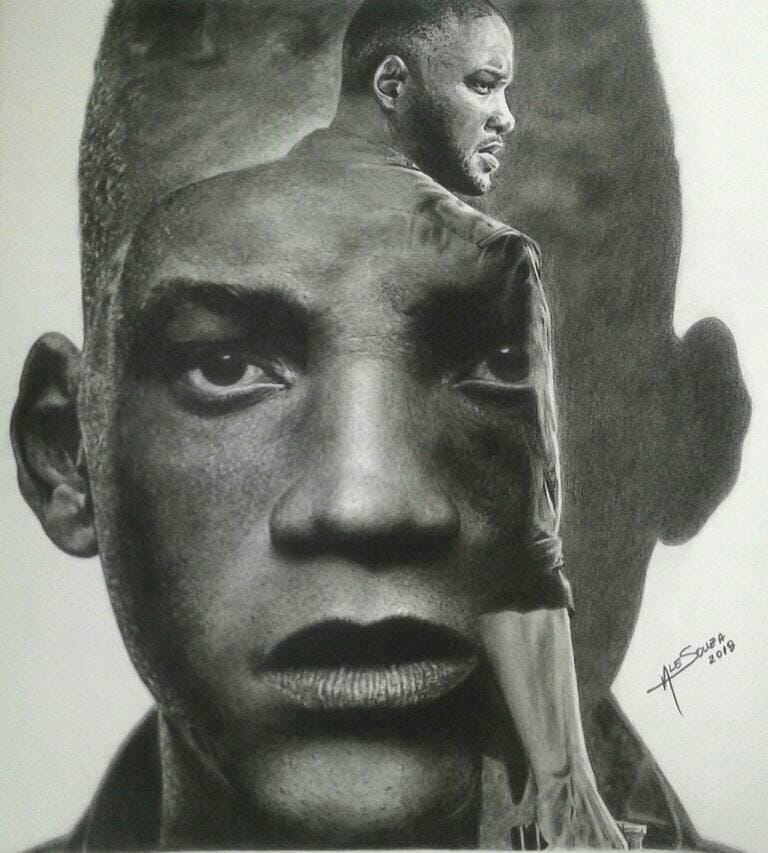
In a realistic pencil drawing, the face, object or scene is judged against the reference. If the eye is too large, the mouth is shifted or the shadow is in the wrong value, the resemblance starts to fall apart. That is why the realistic side depends so much on measuring, comparing and correcting small differences.
In cartoon drawing, the artist may deliberately enlarge the same eye or compress the mouth because the design needs expression. This is where caricature sits: it observes a real person closely, then pushes selected features until the idea becomes visible. The drawing is not careless; it is selective.
The mistake I see most in my students is trying to do both at once before they understand either one. A slightly exaggerated portrait can look accidental rather than intentional. If you want to understand the realist side more deeply, start with realistic pencil drawing as its own discipline first.
Cartoon vs realistic art: what changes in purpose?
Cartoon art usually puts communication first, while realistic art usually puts resemblance first. A cartoon can carry humour, social criticism, tenderness or satire in a single simplified gesture. Realistic art can also be expressive, but it normally asks the viewer to trust the observation before reading the emotion.
That purpose affects every technical choice. In realism, I keep asking whether the form matches the reference: is the cheek turning softly, is the nose sitting at the correct angle, is the hair mass darker than the skin? In cartoon work, the better question may be whether the shape reads clearly at once.
This is why newspaper cartoons and caricatures often borrow from realism without becoming realism. A cartoonist may understand anatomy, likeness and facial rhythm very well, then sacrifice exact proportion for a sharper message. A realistic artist may draw a funny expression, but the expression still has to remain believable in the subject’s real face.
The Tate describes chiaroscuro as the balance of light and shade in art. That idea belongs strongly to realism, because value builds the illusion of form. Cartoon art can use it too, but it may rely more on outline, silhouette and graphic rhythm.
Difference between cartoon and realistic drawing in technique
The technical difference is that realistic drawing is value-led and observation-led, while cartoon drawing is often line-led and design-led. Realism asks for careful proportion, gradual tonal changes and textures. Cartoon drawing asks for clear shapes, controlled exaggeration and readable expression.
Here is the compact comparison I give beginners before they choose a practice path:
| Aspect | Cartoon | Realistic |
|---|---|---|
| Purpose | Communicates an idea fast | Builds faithful resemblance |
| Shape | Simplified or exaggerated | Measured from reference |
| Line | Often dominant | Often softened or hidden |
| Value | Used when useful | Essential for form |
Realistic drawing usually starts with the reference and keeps returning to it. The artist compares distances, angles, edges, light and shadow. If you are learning this path, drawing what you see is the habit that changes the work most.
Cartoon drawing can begin from the same reference, but the reference becomes raw material rather than a strict target. You may take the rhythm of a beard, the tilt of a head or the curve of a smile and turn it into a design. In my teaching, I call this honest distortion: it only works when the artist has really looked first.
Is cartoon or realistic drawing easier?
Realistic drawing is often easier to measure, while cartoon drawing is often easier to start. A beginner can compare a realistic drawing with a photograph and see whether the proportions, shadows and textures are close. Cartoon drawing feels freer, but the feedback is less objective.
With realism, the path is direct: learn proportion, light, shadow, texture and edge control, then repeat. The result may be slow, but the comparison is visible. When I blend a cheek or correct a mouth, I can point to the reference and show exactly why the drawing improved.
With cartoons, a beginner may enjoy the freedom at once. The difficulty comes later, because a cartoon has to communicate. Did the joke land? Did the pose read? Did the exaggeration feel deliberate? Those answers are more subjective, especially with satire or caricature.
A sensible order for many students is:
- Practise simple construction so heads and objects have a clear centre and tilt.
- Study proportion from references, even if your final style is cartoon.
- Use light and shadow to understand volume, not only decoration.
- Exaggerate one feature at a time so the distortion looks intentional.
- Return to observation whenever the drawing starts to look vague.
If your aim is progress you can check week by week, realism gives clearer feedback. If your aim is storytelling, expression or humour, cartoon drawing may keep you more engaged. Neither route is lesser; each asks for a different kind of attention.
Do cartoonists need realistic drawing fundamentals?
Yes, cartoonists benefit from realistic drawing fundamentals because simplification is stronger when it comes from knowledge. Construction, proportion, light, shadow and facial observation help a cartoonist decide what to keep, what to remove and what to exaggerate.
A flat cartoon line can be charming, but it still needs structure underneath. If the head has no centre line, the eyes may drift. If the body has no simple form, the pose can become stiff. That is why many cartoonists practise anatomy and perspective even when the finished art looks simple.
Realism also teaches restraint. When students learn light and shadow drawing, they realise that a small value shift can turn a form more convincingly than a heavy outline. Cartoon artists can use the same lesson in a simplified way.
This is especially useful when a cartoon style needs volume without becoming fully realistic. If you want a character to feel round rather than flat, the same principles behind making drawings look 3D still apply: form, edge and value have to agree.
Caricature vs realistic drawing: where is the line?
Caricature sits between observation and exaggeration: it studies real features, then distorts selected ones for likeness, humour or emphasis. Realistic drawing stops before that distortion. It may show an unusual expression, but it does not enlarge the nose or reshape the eyes beyond what the reference supports.
This distinction matters because caricature is not simply bad realism. A good caricature often depends on sharper observation than a stiff realistic copy. The artist must notice which feature carries the person’s recognisable rhythm: perhaps the beard, the jaw, the eyebrows or the posture.
Think of political caricature, where an iconic beard or a heavy brow becomes a visual shortcut the reader recognises in an instant. Cartoon and caricature work the same way: exaggeration is not a mistake when it is the language of the drawing.
When I review a student’s portrait, I ask whether the change was chosen or accidental. If the face has become broader because the artist lost the measurements, that is a proportion error. If the face has become broader to make a caricature read more clearly, that is a design choice.
Can you be good at cartoon and realistic drawing?
Yes, you can be good at both cartoon and realistic drawing, but it helps to separate the practice. Realism trains precision and patience. Cartoon drawing trains selection, rhythm and communication. They share observation, yet they ask the hand and eye to make different decisions.
I often suggest warming up differently for each mode. Before realism, draw small value scales, check angles and practise soft transitions. Before cartoon work, draw quick expressions, silhouettes and variations of one feature. The shift tells your hand what kind of problem it is solving.
There is also a useful overlap. A realist who studies cartooning may become better at expression and gesture. A cartoonist who studies realism may become better at construction and believable form. For beginners who feel unsure where to begin, how to learn to draw gives a steadier foundation than jumping between styles every day.
Materials can stay simple for either route. Realistic pencil work usually needs graphite pencils, paper, blending tools and an eraser (rubber), while cartoon drawing may add ink or digital colour. If you are buying in the UK, Jackson’s Art, Cass Art and Hobbycraft are familiar places to compare basic drawing materials; Amazon.co.uk is also an option, especially for replacement pencils and paper.
There is a long tradition of reliable art materials in the UK. Derwent traces its pencil heritage to 1832 in the Lake District, and Winsor & Newton is a London art materials maker founded in 1832. Those names are not required, but they are useful examples of why checking materials carefully is part of serious practice.
Realistic vs cartoon drawing: how should you choose?
Choose realistic drawing if you want faithful resemblance and measurable practice; choose cartoon drawing if you want simplified communication, humour, character or satire. If you want both, practise them as related but separate skills, then combine them only when you can control the difference.
For a portrait from a photograph, realism asks you to honour the reference. You study the distance between features, the softness of the skin texture, the direction of the light and the exact shape of the shadows. The creativity is in how patiently you use technique to reach what is already there.
For a cartoon or caricature, the creativity is freer. You can remove detail, push a feature, add a visual joke or use a bolder outline. Still, the strongest cartoons usually come from someone who has observed the subject carefully enough to know what can be changed without losing recognition.
My practical advice is modest: choose one aim for the drawing before you start. If the aim is resemblance, protect proportion and value. If the aim is cartoon expression, protect clarity and intention. The paper becomes much less confusing when the drawing knows what language it is speaking.
Frequently Asked Questions
Is cartoon or realistic drawing easier?
Realistic drawing is usually easier to assess, while cartoon drawing is often easier to begin. With realism, you can compare your work with a photograph and see whether the proportions, edges and values are close.
Cartoon drawing feels freer, but it still needs design judgement. A simplified face has to read clearly, and an exaggerated feature has to look chosen. For many beginners, the best route is to learn basic observation first, then simplify with more confidence and less guesswork.
What is the difference between cartoon and realistic drawing?
The difference is purpose: realistic drawing aims for faithful resemblance, while cartoon drawing uses simplification or exaggeration to communicate. Realism protects proportion, texture, light and shadow. Cartooning protects clarity, expression and rhythm.
Both can start from the same photograph. One artist may copy the reference closely; another may enlarge a smile or sharpen a gesture. The skill is not in choosing the more respectable style, but in making the choice deliberately, keeping that choice consistent and judging the result by the right aim.
Can a realistic artist draw cartoons?
Yes, a realistic artist can draw cartoons, but they may need to loosen their habits. Realism trains careful correction, so the first cartoon attempts can feel stiff or overworked.
The useful bridge is observation. A realist already knows how to notice structure, likeness and light. To cartoon well, they must then decide what to leave out, what to exaggerate and how much detail the idea actually needs. A few quick expression studies help make that shift feel less precious and more natural.
Do cartoonists need to learn realism?
Cartoonists do not have to become realistic artists, but realism fundamentals help a great deal. Construction, proportion and value make simplified drawings more believable.
A cartoon head can be two dots and a line, but a character with volume needs an underlying form. Learning realism gives the cartoonist more choices: flat graphic style when wanted, stronger structure when the drawing needs weight, and more control when a pose becomes difficult or the character turns in space during action scenes and quick sketches.
Did this article help you? You can buy me a coffee so I can keep creating free guides like this one.